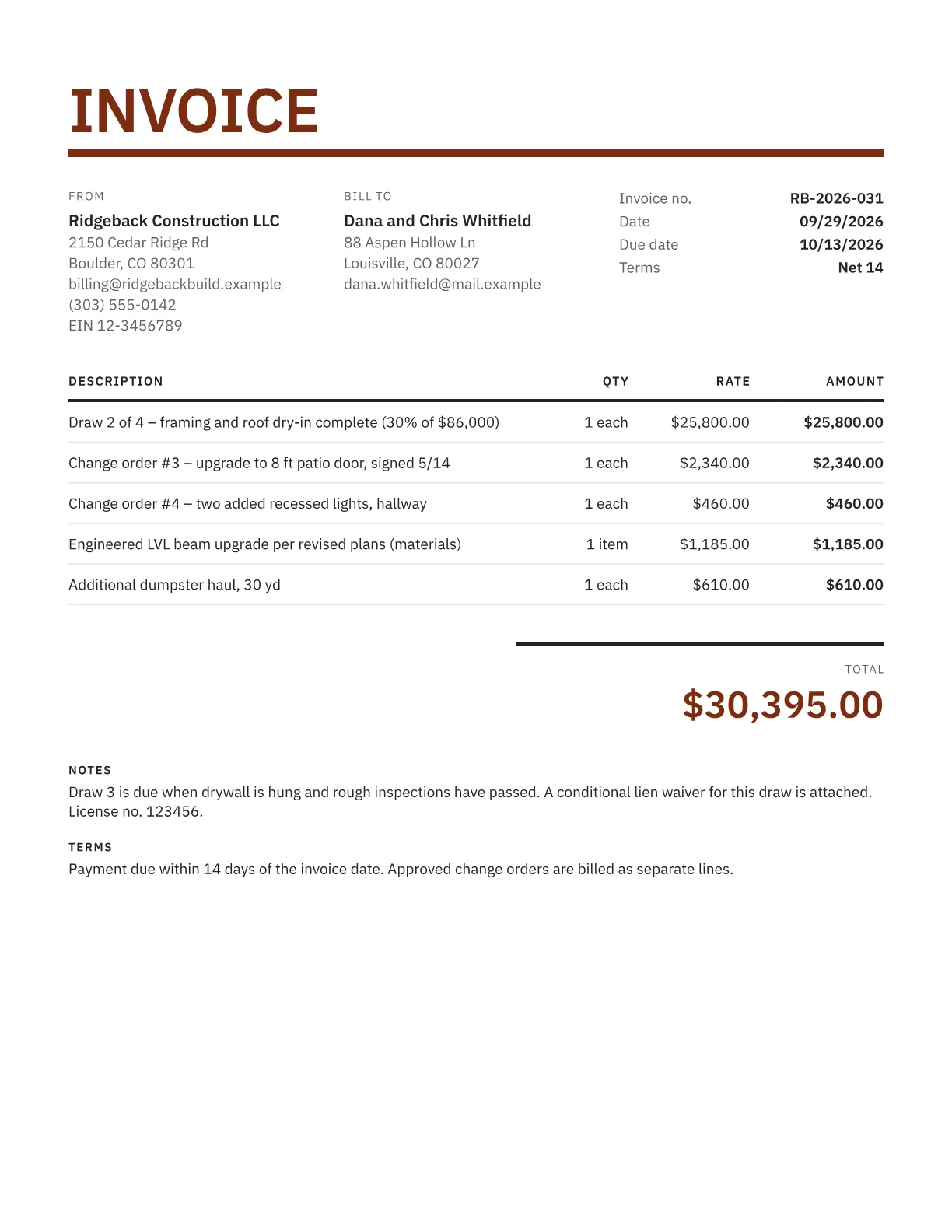
What to include on a contractor invoice
Clients and lenders check every line against the contract, so include:
- Your business name, address, phone and license number. Many states require the license number on contracts and bids, and printing it on invoices is common practice; check your state's contractor board.
- The client's name, billing address and job site address.
- Invoice number, issue date, due date and project name.
- The draw number and percentage complete, such as draw 2 of 4.
- Labor, materials and pass-through costs like permits on separate lines.
- Each approved change order on its own line.
- Payments received so far and the balance due.
Deposits, progress draws and retainage
Jobs longer than a couple of weeks are usually billed in stages: a deposit at signing, then draws tied to milestones the client can see, such as framing, rough-in inspections, drywall and final walkthrough. Deposits of 10% to 30% are common where state law allows them.
Bill each draw as a percentage of the contract with the dollar figure next to it: 'Draw 2 of 4, framing complete, 30% of $86,000: $25,800.' Enter earlier payments in the amount-paid field and the invoice shows the balance due.
Commercial and public jobs often withhold retainage, typically 5% to 10% of each progress payment, until completion. Show the amount held on every draw and bill the release separately. Send any lien waiver the owner or lender requires with each draw.
Change orders and sales tax
Get every change order signed before the work starts, then bill it on its own line with its number and signed date, never folded into a draw. If your state taxes materials, split it into labor and materials lines.
Sales tax on construction depends on your state, so use the per-line taxable toggle to tax only the lines your state requires.
From estimate to invoice
Price the job with the estimate generator, or send a quote that converts to an invoice in one click. The free contractor invoice is also available as a Word, Excel or PDF download. Independent contractors billing for professional services rather than construction should use the freelance invoice instead.
Prefer a file?
Download this template, prefilled with typical line items. No email needed.
Frequently asked questions
How much deposit can a contractor charge?
It depends on the state and the job. Deposits of 10% to 30% are common on residential work, but some states cap them. California law, enforced by the Contractors State License Board, limits most home improvement down payments to $1,000 or 10% of the contract price, whichever is less, and Maryland generally caps home improvement deposits at one-third of the contract price. Check your state's contractor board first.
Do contractors charge sales tax on invoices?
Sometimes. Depending on the state, tax may apply to the materials line, to the whole contract, or to nothing on the invoice because you paid tax when you bought the materials. Mark each line taxable or not in the generator, and confirm the rule with your state revenue department or an accountant.
What is retainage on a construction invoice?
Retainage is a share of each progress payment, usually 5% to 10%, that the owner holds back until the project is substantially complete. It is common on commercial and public jobs. Record the amount withheld on each draw so both sides can track it, and send a separate invoice for the release when the work is finished.
Should a lien waiver go out with every invoice?
On draw-based jobs, owners and lenders often ask for a conditional lien waiver with each payment request, then an unconditional waiver once the payment clears. A conditional waiver only takes effect when you are actually paid. Several states require a specific statutory form, so use your state's version.
How do I bill a change order?
Put it on its own line with the change order number, the date it was signed and a short description. Many contractors add approved change orders to the next draw once the work is done. Keep them out of the base contract amount so the client can match each one to the signed paperwork.