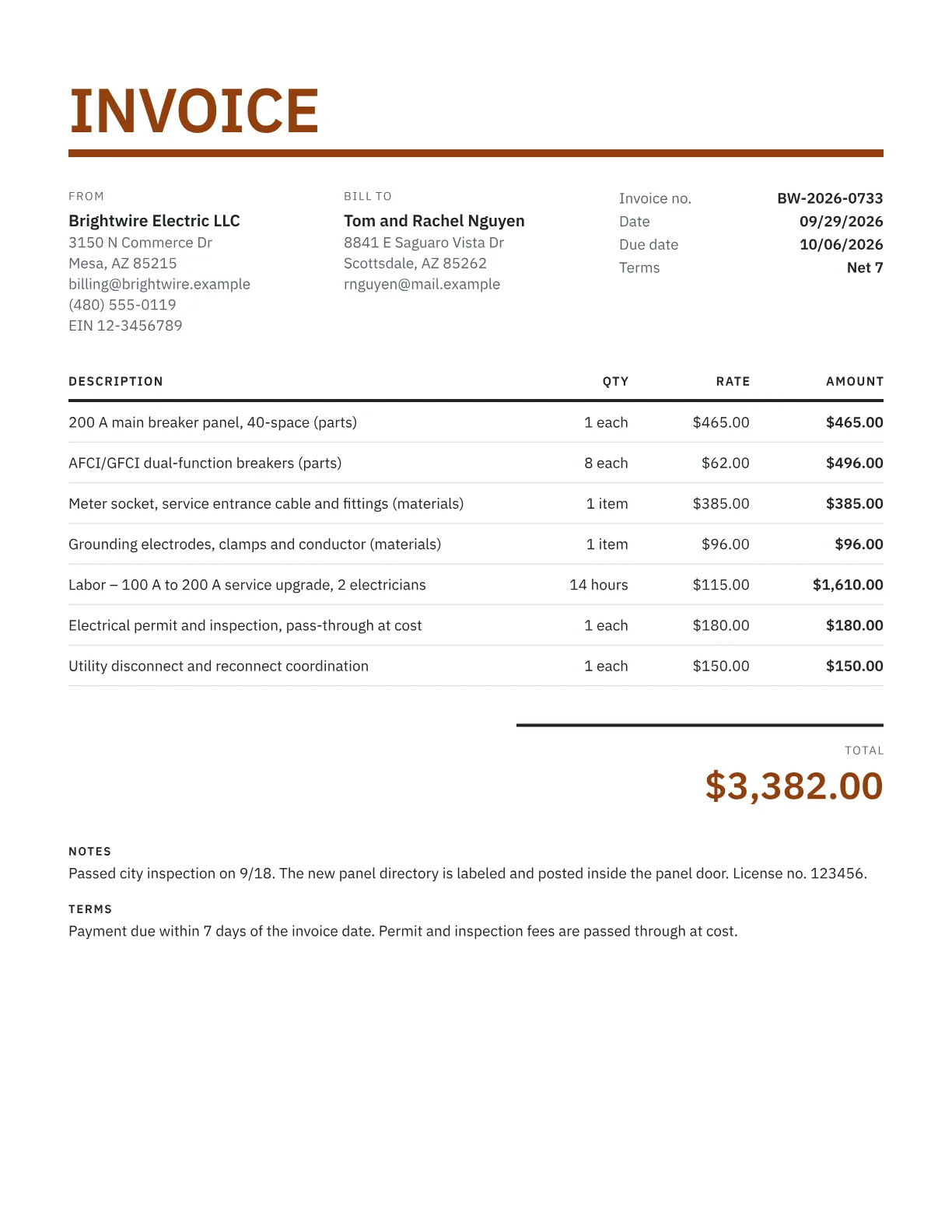
What to include on an electrician invoice
- Your business name, contact details and license number. Most states license electricians, and many require the number on bids and contracts; check your state licensing board.
- The customer's name and job address.
- Invoice number, service date and due date.
- The work performed, with the location or circuit where useful.
- Trip charge or minimum charge.
- Labor hours, crew size and rate.
- Devices, breakers and wire with quantities.
- Permit and inspection fees.
- Payment received and the balance due.
Parts, permits and flat-rate pricing
Listing each device and breaker type shows the customer what went into the wall, supports warranty claims, and lets you tax materials separately if your state requires it. Small consumables such as wire nuts, staples and tape can share one materials line.
Pass permit and inspection fees through at cost on their own line. If the inspector calls for work outside the original scope, get the customer's approval and bill it as a separate line.
Many electricians price common tasks at a flat rate. That works on an invoice as long as the line says what's included, such as 'Install ceiling fan on existing fan-rated box, includes mounting hardware.'
Trip charges, minimums and after-hours work
A trip charge, often $50 to $100, or a one-hour minimum covers drive time on small jobs. State which one you use, so a 20-minute outlet swap doesn't surprise anyone. For emergency calls at night, on weekends or on holidays, bill the standard rate plus a separate premium line, commonly 1.5 to 2 times the standard rate. Commercial clients may need a PO number and a lien waiver with each invoice, so ask before you bill.
Quote larger jobs with the estimate generator. The free electrician invoice is also available as a Word, Excel or PDF download.
Prefer a file?
Download this template, prefilled with typical line items. No email needed.
Frequently asked questions
Do electricians charge sales tax?
It depends on the state and the type of job. Materials are commonly taxable, labor on residential repairs often is not, and some states tax electrical services or whole construction contracts. Keep labor and materials on separate lines, mark each one in the generator, and confirm the rule with your state revenue department.
Should I list every breaker and device?
List the main components with quantities, such as breakers, receptacles, fixtures and panels, and group small consumables into one materials line. Itemizing the major parts documents what was installed, which helps with warranty claims, insurance questions and future service calls on the same system.
What's the difference between a trip charge and a service call fee?
A trip charge covers getting a licensed electrician and a stocked truck to the site, usually as a flat amount. A service call fee often includes diagnosis time as well. Either is fine; name it clearly on the invoice and say whether it is credited toward the repair if the customer approves the work.
How do I invoice a panel upgrade?
Separate the panel, breakers and service materials from labor, then add the permit, inspection and any utility coordination fees on their own lines. Note the inspection date and result in the invoice notes. On larger upgrades many electricians take a deposit for materials and show it as an amount paid.
Can I charge more for after-hours calls?
Yes, as long as the customer agrees to the rate before you start. Premiums of 1.5 to 2 times the standard rate are common for nights, weekends and holidays. Show the standard labor and the premium on separate lines, and note the time of the call, so the customer can see what the after-hours rate added.