GST/HST rates by province and territory (2026)
These are the rates published by the CRA. They have not changed since Nova Scotia cut its HST from 15% to 14% on April 1, 2025.
| Province or territory | Tax | Rate | Provincial sales tax |
|---|---|---|---|
| Alberta | GST | 5% | None |
| British Columbia | GST | 5% | 7% PST |
| Manitoba | GST | 5% | 7% PST |
| New Brunswick | HST | 15% | Included in HST |
| Newfoundland and Labrador | HST | 15% | Included in HST |
| Northwest Territories | GST | 5% | None |
| Nova Scotia | HST | 14% | Included in HST |
| Nunavut | GST | 5% | None |
| Ontario | HST | 13% | Included in HST |
| Prince Edward Island | HST | 15% | Included in HST |
| Quebec | GST | 5% | 9.975% QST |
| Saskatchewan | GST | 5% | 6% PST |
| Yukon | GST | 5% | None |
How to show the tax
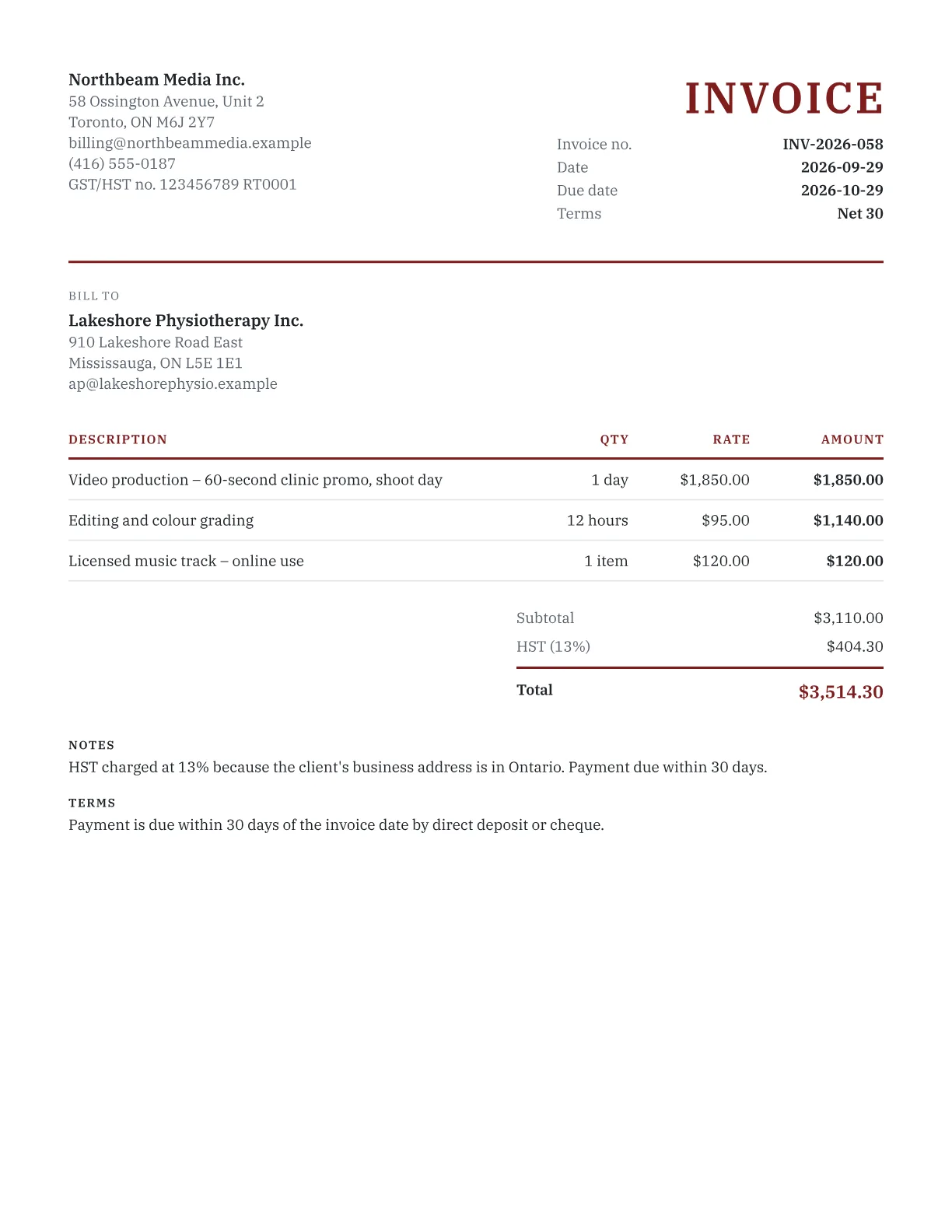
For taxable sales other than zero-rated ones, the CRA says you must tell your customer about GST/HST in one of these ways: show the tax as a separate amount, state that the total includes GST/HST, or show the rate that applies. With HST, show the total rate, such as 13%, not the federal and provincial parts.
For a $1,000 job billed to an Ontario client, either list HST of $130 and a total of $1,130, or show $1,130 with the note "HST included at 13%". Clients claiming input tax credits on sales of $100 or more also need your GST/HST registration number on the invoice.
Which province's rate applies
The place-of-supply rules set the rate, not the location of your business.
- Goods: charge the rate of the province where you deliver them or make them available, including goods you ship or courier there. An Ontario furniture maker delivering a desk to a customer in Newfoundland and Labrador charges 15% HST.
- Services: generally charge the rate of the province of your client's home or business address, as you obtain it in the ordinary course of business. A Calgary designer billing a client with a Halifax business address charges 14% HST.
Services related to real property, personal services and some others follow specific rules, so check the CRA's place-of-supply guidance when a job crosses provincial lines.
Frequently asked questions
Can I show the federal and provincial parts of HST separately?
No. The CRA asks you to show the total HST rate, for example 13% in Ontario or 15% in New Brunswick, rather than splitting it into the 5% federal part and the provincial part.
Why does the generator start at 13%?
13% is the HST rate in Ontario, used here as an example. Change it to 5% for provinces and territories that charge only GST, 14% for Nova Scotia, or 15% for New Brunswick, Newfoundland and Labrador and Prince Edward Island, depending on where the supply is made. Switch the tax label to GST where only GST applies.
Are PST and QST part of GST/HST?
No. In British Columbia, Manitoba and Saskatchewan, provincial sales tax is separate, and the CRA says to calculate GST on the price excluding PST. In Quebec, Revenu Québec administers both the GST and the 9.975% QST, and each tax is calculated on the selling price before the other is added.
How do I handle zero-rated items on a GST/HST invoice?
Turn tax off for those lines with the per-line tax switch. Basic groceries, prescription drugs and most exports are examples of zero-rated supplies, taxed at 0%. If an invoice of $100 or more mixes taxable and exempt items, clients claiming input tax credits need the status of each item shown.
What was Nova Scotia's HST rate before April 2025?
15%. It dropped to 14% on April 1, 2025. If you are billing or correcting an invoice for a supply that straddles that date, check the CRA's transitional rules for the Nova Scotia rate change to see which rate applies.