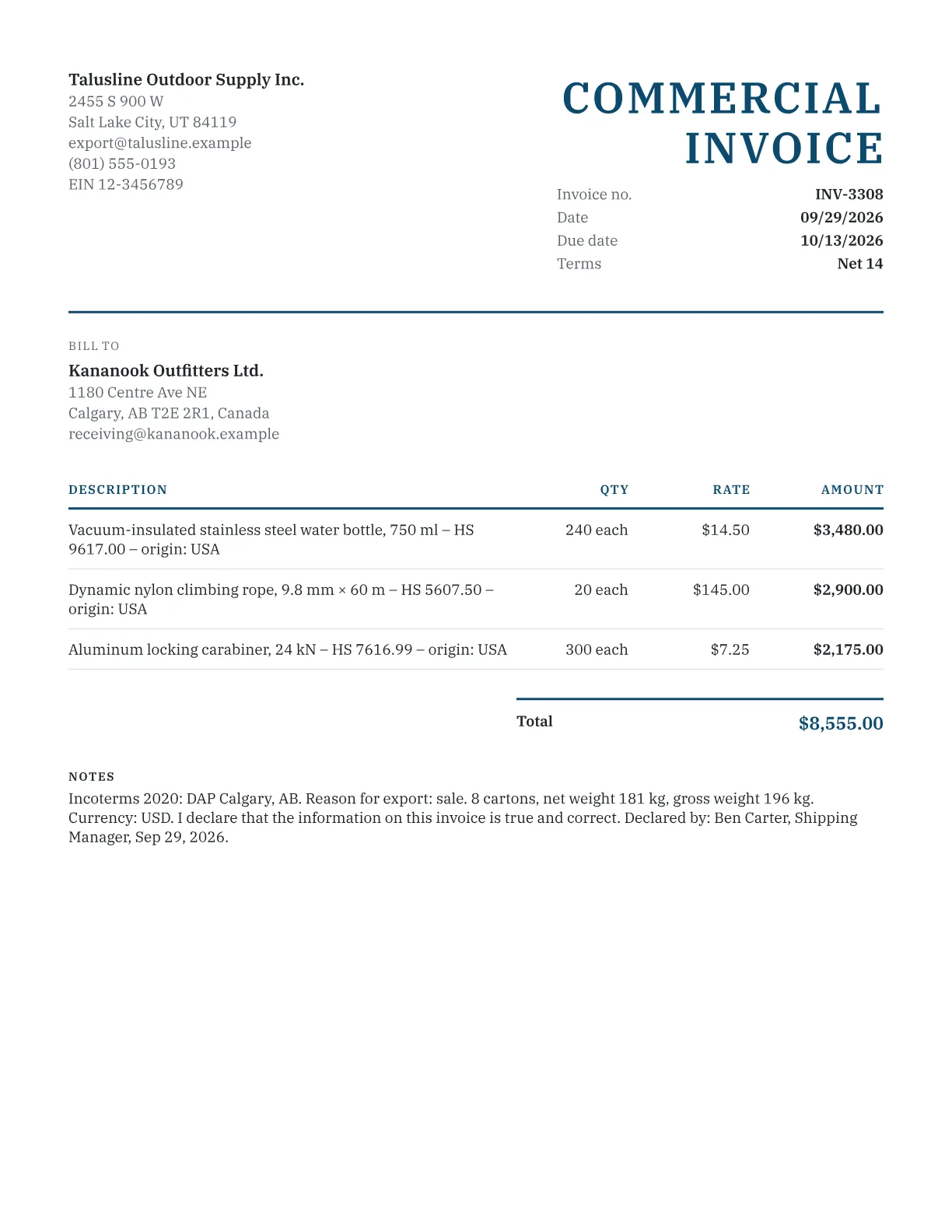
What customs needs on a commercial invoice
- Shipper or exporter: name, address, contact details and tax ID, such as your EIN
- Consignee: the buyer or receiver, plus the importer of record if different
- Invoice number and date
- Description of each item: what it is, what it's made of and what it's for
- HS code and country of origin for each line
- Quantity, unit value and line total
- Total value and currency
- Incoterms rule with a named place, such as DAP Calgary
- Reason for export: sale, sample, gift, repair or return
- Packages: how many, with net and gross weight
- A signed declaration that the information is true and correct
Descriptions and HS codes
Vague descriptions are a common reason for customs holds. “Parts” or “clothing” will be queried; “men's cotton knit T-shirts” won't. The first six digits of an HS code are shared worldwide, and the US adds more: 10-digit HTS codes for imports and Schedule B numbers for exports. For goods entering the US, CBP lists the required invoice contents in 19 CFR 141.86, including itemized charges such as freight and insurance.
Incoterms, value and export filings
The Incoterms rule tells customs and your buyer who pays for freight, insurance and import duties; Incoterms 2020 is the current edition. Under DAP Calgary, for example, you pay transport to Calgary and the buyer handles Canadian duties and taxes. If you charge the buyer for freight, show it on its own line.
US exports valued over $2,500 per Schedule B number, or needing a license, also require an Electronic Export Information filing in AES. Most shipments to Canada are exempt.
Carrier and customs forms
Carriers such as UPS, FedEx and DHL set their own paperwork rules. Some generate a commercial invoice from your shipment data or ask you to use their form, and many want signed copies with the package. Customs authorities may also require specific forms or origin certifications, for example to claim lower duty rates under a trade agreement. Keep every document consistent: the same values, quantities and descriptions throughout.
Frequently asked questions
How is a commercial invoice different from a regular invoice?
A regular invoice asks your customer for payment. A commercial invoice is also a customs document, so it adds what border agencies need to classify, value and admit the goods: HS codes, country of origin, weights and the Incoterms rule. For a sale, one document can do both jobs.
Who signs the commercial invoice?
Usually the exporter or shipper, or an employee or agent authorized to sign for them. Carriers generally ask for a signed declaration that the contents are true and correct. Print the PDF, sign it and attach copies as your carrier instructs.
Do I need a commercial invoice for samples or gifts?
Usually, yes. Customs needs a value even when nothing is sold, so state a realistic value and the reason for export, such as “sample, no commercial value”. That wording doesn't make goods duty-free. Carriers often call this document a proforma invoice.
Which currency should I use?
Use the currency of the sale, as agreed with your buyer, and state it clearly on the invoice. Customs converts the value using its own official exchange rate, so don't convert figures yourself unless the destination country asks you to.