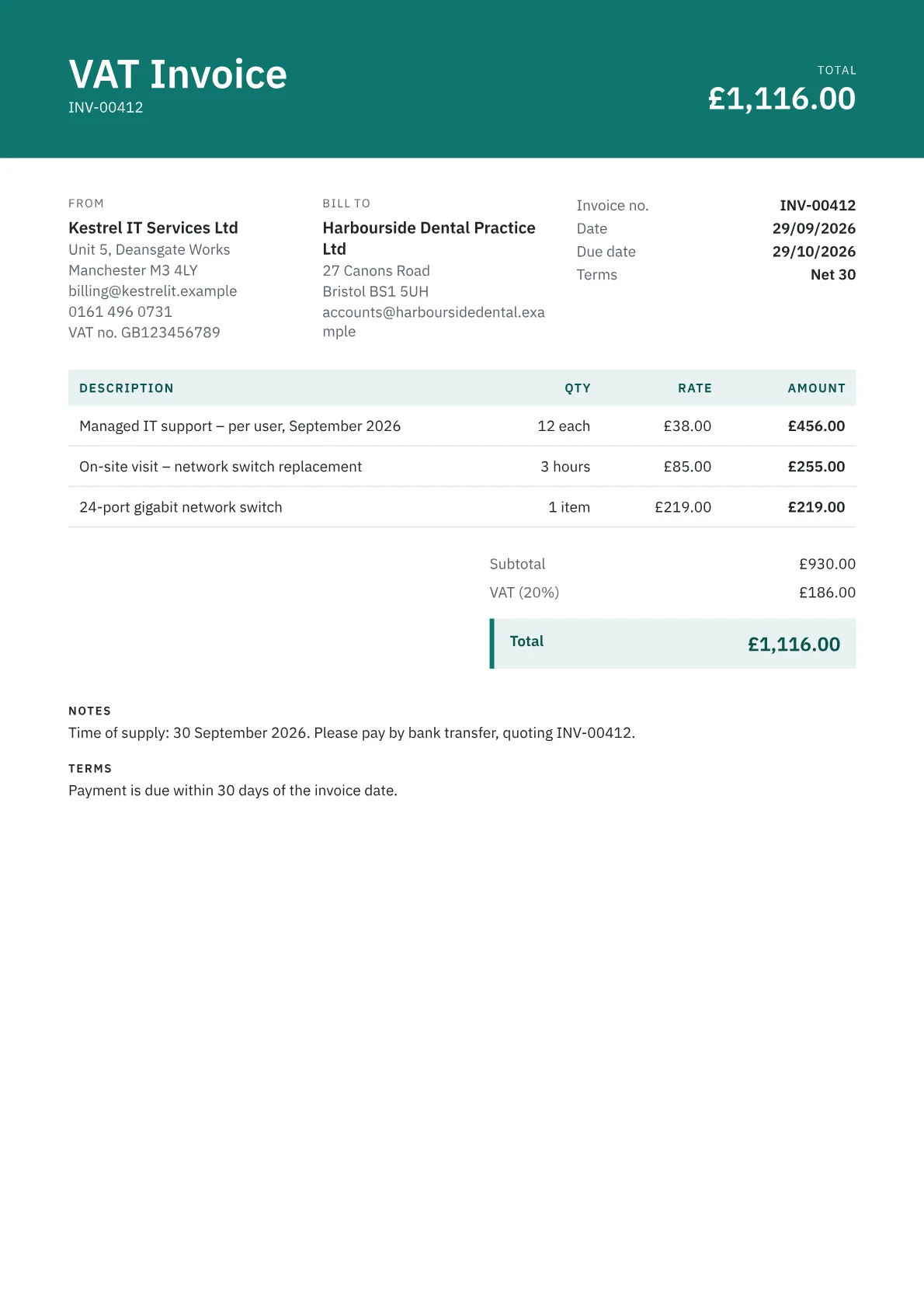
What HMRC requires on a full VAT invoice
HMRC's VAT Notice 700 (section 16) says every VAT invoice must show:
- A unique, sequential invoice number
- The time of supply (tax point), plus the issue date if it is different
- Your name, address and VAT registration number
- Your customer's name and address
- A description that identifies the goods or services
- For each line: the quantity, the unit price, the VAT rate and the amount excluding VAT
- The total excluding VAT, and the rate of any cash discount offered
- The total VAT, shown in sterling
If the invoice also includes zero-rated or exempt items, show clearly that no VAT is due on them and give their total separately. You should normally issue a VAT invoice within 30 days of the time of supply.
Simplified and modified VAT invoices
For a supply of £250 or less including VAT, you can issue a simplified invoice if your customer agrees. It needs only:
- your name, address and VAT registration number
- the time of supply
- a description of the goods or services
- for each VAT rate, the total including VAT and the rate charged
Exempt supplies cannot go on a simplified invoice. Above £250 you must issue a full VAT invoice or, if the customer agrees, a modified invoice. A modified invoice shows VAT-inclusive line values, with the VAT-inclusive total, the VAT, the VAT-exclusive total and any zero-rated total at the foot.
VAT rates and the construction reverse charge
The standard rate is 20%. The reduced rate of 5% covers items such as home energy and children's car seats, and the 0% zero rate covers most food and children's clothes. Check HMRC's rates guidance for your own goods.
Since 1 March 2021, most building and construction services supplied between VAT-registered businesses within the Construction Industry Scheme use the domestic reverse charge. You still issue a VAT invoice, but you do not add the VAT to the amount charged. The invoice must say that the reverse charge applies and that the customer accounts for the VAT, and state the VAT amount (or the rate). HMRC accepts wording such as "Reverse charge: customer to pay the VAT to HMRC". In the generator, switch VAT off on those lines and put the wording and the VAT amount in the notes. Supplies to end users and intermediary suppliers who notify you in writing are treated differently, so check HMRC's reverse charge guide.
Frequently asked questions
Can I issue a VAT invoice if I am not VAT-registered?
No. Only VAT-registered businesses can issue VAT invoices or charge VAT. If you are not registered, use the standard UK invoice generator with VAT set to 0%. You must register with HMRC once your taxable turnover for the last 12 months goes over £90,000, or you expect it to in the next 30 days.
Can a VAT invoice be in euros or dollars?
Yes. Prices and totals can be in any currency, but for supplies that take place in the UK the total VAT must also be shown in sterling. Paragraph 7.6 of VAT Notice 700 explains which exchange rates you can use for the conversion.
When do I have to issue a VAT invoice?
Whenever you make a standard-rated or reduced-rated supply to another VAT-registered business, normally within 30 days of the time of supply. You do not have to issue VAT invoices for zero-rated supplies or to customers who are not VAT-registered, although many businesses issue one to anyone who asks.
Is a pro forma invoice a VAT invoice?
No. GOV.UK says customers cannot reclaim VAT using a pro forma invoice, a statement or a delivery note. You can send a pro forma to request payment in advance, then issue a proper VAT invoice for the supply so your customer can reclaim the VAT.