What to include on a plumbing invoice
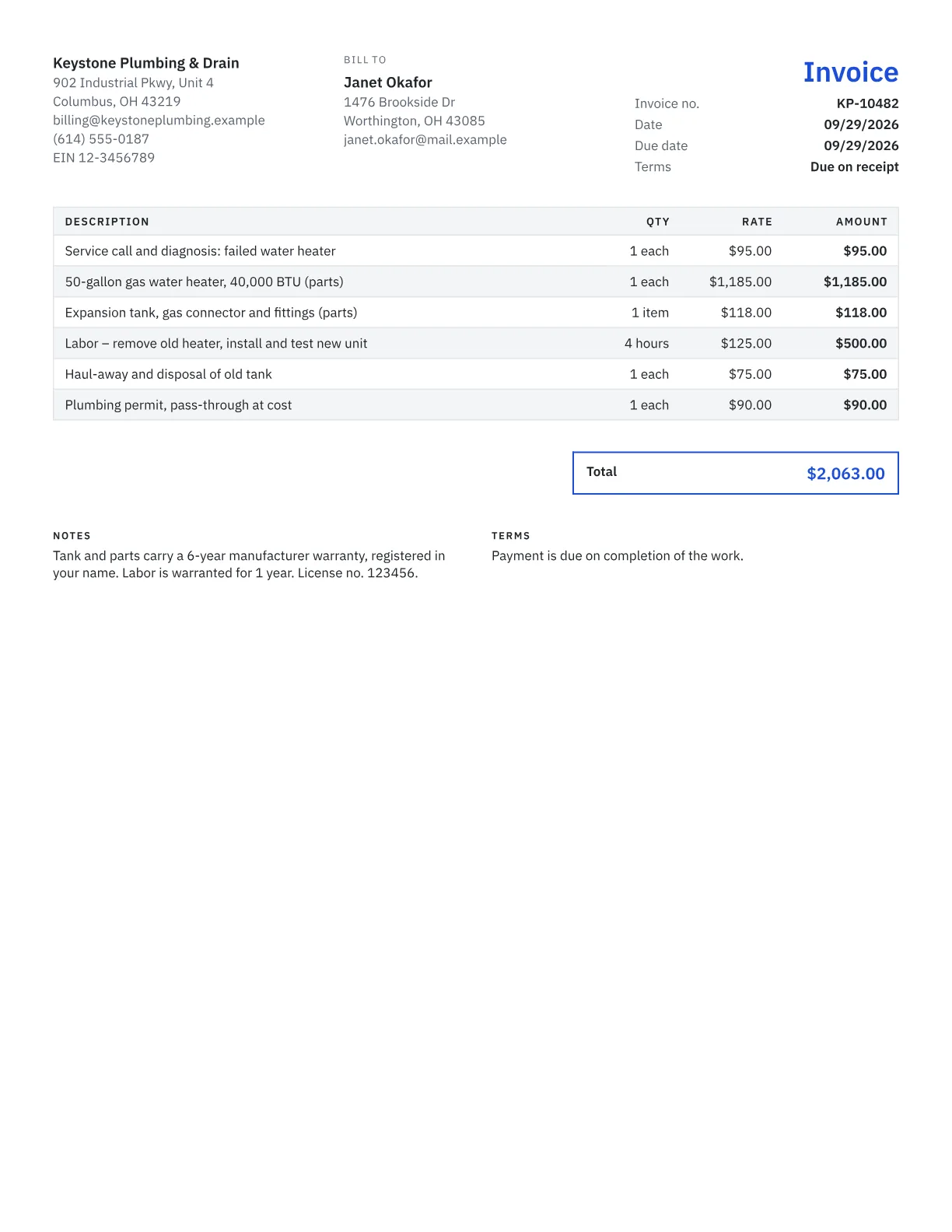
- Your business name, phone and license number, if your state or city licenses plumbers.
- The customer's name and service address.
- Invoice number, date of service and due date.
- The problem found and the work done, in plain words.
- Service call or trip fee.
- Labor hours and rate, with any after-hours premium on its own line.
- Parts with quantities, marked taxable where your state taxes them.
- Permit and disposal fees.
- Warranty terms and any payment received.
Parts, labor and markup
Listing parts separately answers the question every customer asks: what did I pay for? It also lets you charge sales tax on parts only, if that is how your state works. Markups vary widely, and many shops use a sliding scale, for example 50% on a $20 valve but 20% on a $1,000 water heater. Bill the marked-up price as the part's rate instead of adding a separate markup line.
Permit fees are usually passed through at cost. Label them as a pass-through and keep the receipt. If you price by flat rate, list the major parts under the flat-rate line anyway for warranty records.
Service calls and after-hours rates
Most service plumbers charge a service call or trip fee to cover the drive and diagnosis, commonly $75 to $150 for a daytime visit. Say on the invoice whether it is credited toward the repair. Nights, weekends and holidays are often billed at 1.5 to 2 times the standard rate; show the premium separately, such as 'After-hours premium, 2 hours at $62.50', so the customer can see both.
When the customer pays on the spot, mark the invoice as paid and it becomes a receipt. Free plumbing invoice downloads are available in Word, Excel and PDF format.
Prefer a file?
Download this template, prefilled with typical line items. No email needed.
Frequently asked questions
Should a plumber charge sales tax on labor?
It depends on your state. Parts are often taxable, while repair labor is taxed in some states and exempt in others, and the answer can change between repair work and new construction. Keep labor and parts on separate lines, use the taxable toggle, and confirm the rule with your state revenue department.
What is a normal plumbing service call fee?
Service call fees for a standard daytime visit commonly run $75 to $150, with more for nights, weekends and holidays. Many plumbers credit the fee toward the repair if the customer goes ahead. Whatever your policy, print it on the invoice so the customer knows what the fee covered.
How do I bill emergency plumbing work?
Bill the call-out, then show labor at your standard rate and the emergency premium as a separate line. Premiums of 1.5 to 2 times the standard rate are common for nights, weekends and holidays. Tell the customer the rate before you start and note the time of the call on the invoice.
Do I need to list parts if I use flat-rate pricing?
You don't have to price them separately, but listing the main parts under the flat-rate line helps with warranty claims and repeat visits. If your state taxes parts but not labor, you may need to show the parts portion separately to charge tax correctly, so check with your state revenue department.
How should I bill a permit?
Pass it through at cost on its own line, labeled as a permit fee, and keep the receipt in case the customer asks. If you charge for time spent pulling the permit or meeting the inspector, bill that as a separate labor line instead of inflating the permit amount.